


Best-practices analysis showed where listening was strong, where action broke down, and what to fix first to support aggressive growth.
Challenge: Can our VoC program scale?
This medical technology company had just entered an aggressive growth phase, expanding across products, accounts and markets while carrying newly public performance commitments. Leadership needed confidence that they could sense customer perception shifts fast enough to protect those commitments.
The customer experience team had built a credible Voice of Customer program from a standing start, moving the organization from a long stretch with almost no perception data to a routine, multi-channel listening cadence. But the program had been built for a smaller, simpler company than the one now taking shape.
The open question was not whether the program worked. It was whether a program originally designed for issue resolution could carry the weight of enterprise growth, and where it would break first.
Growth would increase organizational size and complexity faster than the program was designed to absorb.
Listening coverage was concentrated in a single geography and a small group of internal stakeholders.
The program was effectively run by a very small central team, limiting how much could scale manually.
Customer-facing action depended on informal, word-ofmouth follow-through rather than systems.
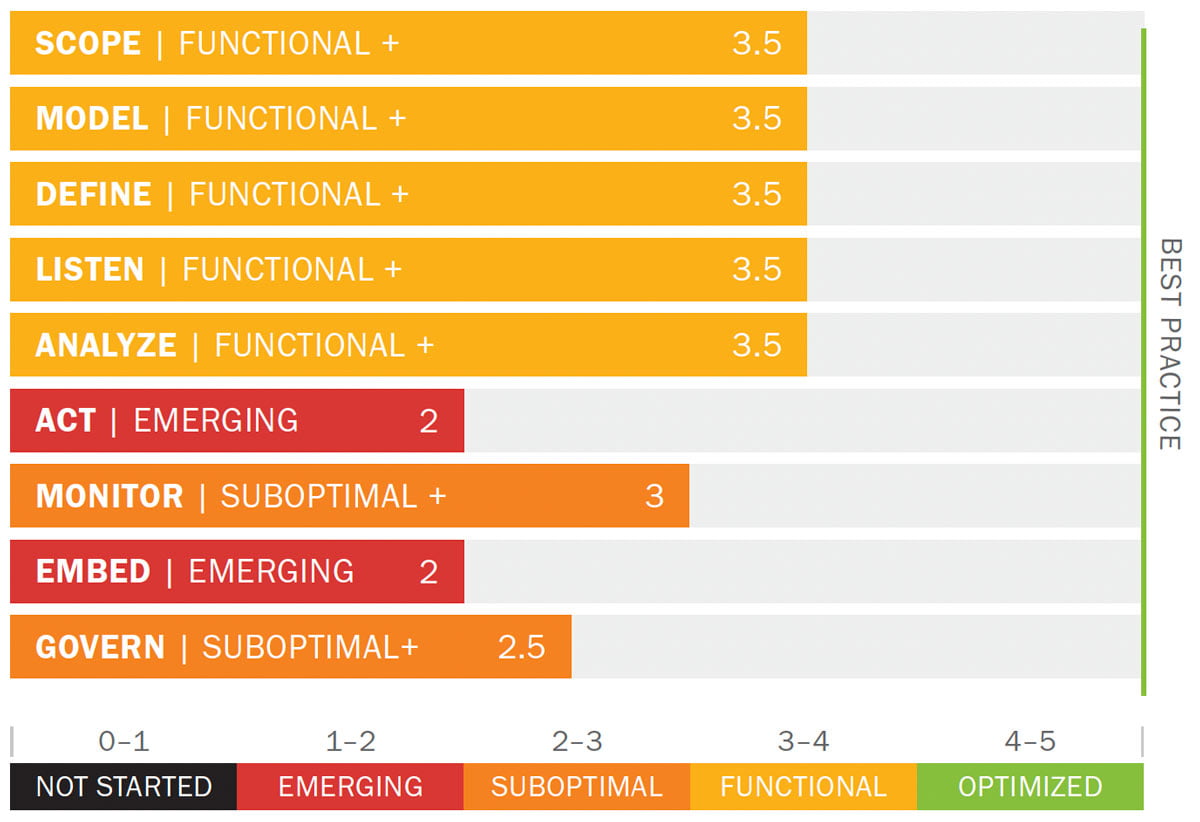
We discovered that our system is strong at collecting and analyzing feedback, but not strong at turning insight into visible, cross-functional action.
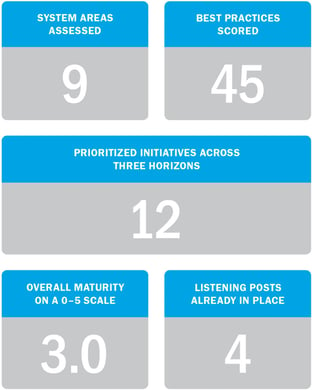
McorpCX ran a structured current-state assessment built on its Voice of Customer framework, which organizes an experience measurement system into nine areas: scope, model, define, listen, analyze, act, monitor, embed and govern.
Each area was scored against defined best practices, using a common maturity scale from not started through best practice. Scoring was grounded in evidence rather than opinion, drawing on the program’s own documentation, dashboards, listening post design, survey instruments and reporting artifacts.
Document mining and leadership discussions were used together, so that what the program claimed on paper could be checked against how insight actually moved through the business. The output was a single, comparable picture of where the program stood and which gaps mattered most to growth.
Discovery interviews and a structured leadership discussion guide
Systematic mining and review of existing VoC program documentation
Best-practice scoring across nine system areas of the measurement framework
Gap prioritization tied to growth risk, not to theoretical maturity
A staged path-forward roadmap with near-, mid- and long-term priorities
Close the loop: Establish visibility into what actually happens after a customer raises an issue, and scale that visibility through dashboards rather than word of mouth.
Evolve the KPI framework: Build an impact model that shows how operations shape perceptions, how perceptions shape customer behaviors, and how those behaviors drive revenue.
Create cross-functional visibility: Extend improvement plans and activity prioritization beyond the customer success organization to the functions that own the fixes.
Stand up CX governance: Formalize a cross-functional CX council with clear roles and accountability, so action on feedback continues consistently as the company grows.
Sequence the work: Stage every recommendation across near-, mid- and long-term horizons so the program builds momentum without outrunning its capacity.
The lowest performing capabilities in the are those that enable accountable actions and measurable impact.
Results: A prioritized, sequenced path forward linked to value
The assessment gave leadership a defensible answer to the question they asked: the program has a solid foundation, but it is not yet built to serve as a growth engine. Strength in scope, modeling, definition, listening and analysis sat alongside clear weakness in acting on and embedding what the program learned.
That framing changed the conversation. Instead of debating whether the program was good, the organization could focus on the two or three constraints that put growth targets at risk, and on the specific moves that would relieve them.
The company left with a prioritized, sequenced path forward: make closed-loop action measurable, prove the business linkage behind the metrics, codify the program’s rigor, and broaden ownership of improvement beyond a single function. Each move ties directly to the organization’s ability to sense and respond as it scales.
By the Numbers


McorpCX is independently recognized as a top customer experience services and solutions company, enabling and guiding leading organizations since 2002.
Touchpoint Mapping®, Touchpoint Metrics® and Loyalty Mapping® are registered trademarks of McorpCX, LLC