


Redesigning the support journey across three cloud businesses to cut customer effort, reduce escalations, and lower cost to serve.
Challenge: A fragmented support experience across clouds and portals
This enterprise cloud-services company operates through three independent business lines. Customers— IT administrators keeping thousands of end users productive—don’t experience three businesses; they experience one brand and expect one support relationship.
Instead, they faced separate portals, intake forms, case-management systems, and severity taxonomies. Misrouted cases went unanswered; handoffs required repeating context and re-uploading logs.
The elements of great support existed, but no one owned the whole.
The result was costly. Customers learned that inflating case severity was the best way to get a timely response, consuming high-cost engineering capacity with cases that didn’t need it and making real emergencies harder to distinguish.
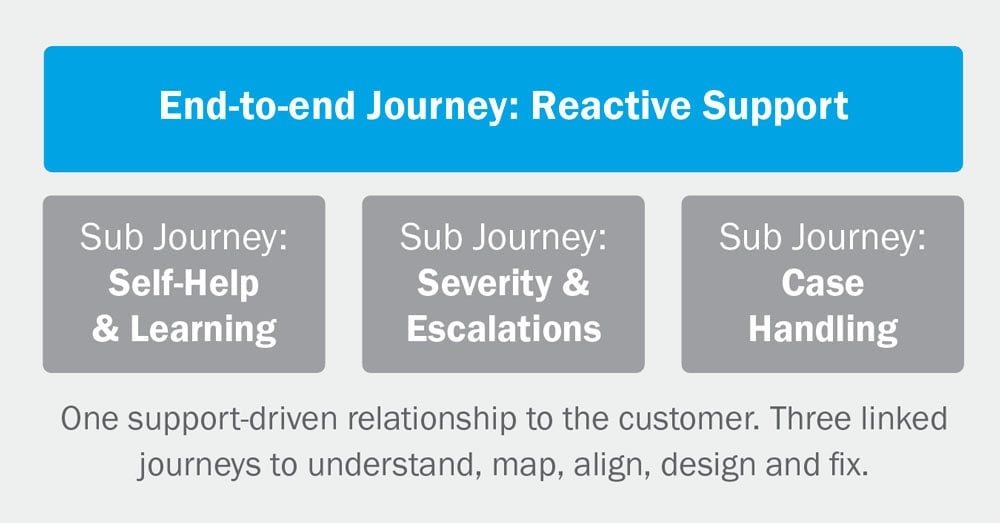
The elements of a great support experience were all there. They were just in different places, owned by different teams.
The constraints we had to design around included three business lines with independent tooling, content systems, and incentives; engineering capacity as the primary operational constraint; multiple improvement efforts already underway but unaligned; and no shared, customer-validated definition of what “good” looked like.
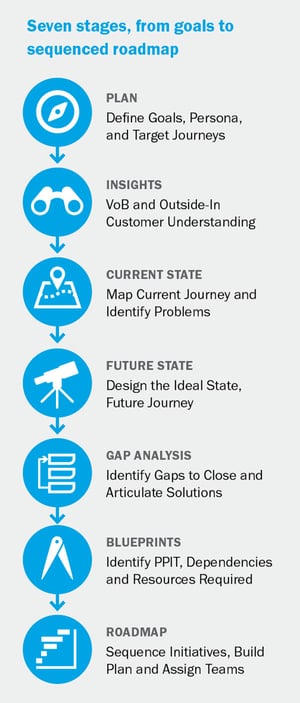
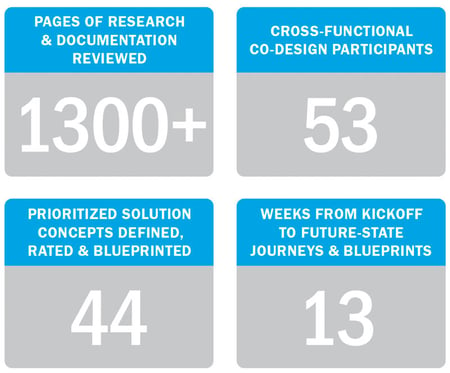
We started by mining what existed rather than conducting new research analyzing more than 1,300 pages of prior studies, telemetry data, process documentation, and journey hypotheses to establish baseline and expose gaps worth investigating. We then paired an outside-in and an inside-out view. First, enterprise customers described the support experience in their own words. Then, we interviewed frontline managers, subject-matter experts, and senior stake-holders across every business line, capturing where the internal and customer stories diverged.
With both perspectives in hand, we convened the organization. Cross-functional stakeholders worked in facilitated breakout groups against one journey each, rating every proposed solution concept for business impact and implementation effort, then working through what each idea would actually require of people, policy, process, and platform.
Finally, we converted the prioritized concepts into service blueprints: the operating detail that turns an aspiration into a fundable initiative.
Activities:
Document review and insight-gap analysis
Enterprise customer interviews and verbatim capture
Internal subject-matter expert and stakeholder interviews across all business lines
Persona development and current-state journey capture, validation, and mapping
Two facilitated co-design and prioritization workshops
High- and mid-fidelity future-state journey mapping
Service blueprinting across five lanes
Results: Unified support, designed around customers
In thirteen weeks, the organization aligned three disconnected improvement efforts around one customer validated vision for a simpler, more consistent enterprise support experience.
Customers’ language shaped future-state journeys and service blueprints designed to reduce effort, improve routing, create clearer handoffs, and make support easier to navigate across business lines.
The 44 prioritized solution concepts gave teams a shared path forward, aligning owners, processes, platforms and measures around the experience customers should receive, not the organizational silos behind it.


McorpCX is independently recognized as a top customer experience services and solutions company, enabling and guiding leading organizations since 2002.
Touchpoint Mapping®, Touchpoint Metrics® and Loyalty Mapping® are registered trademarks of McorpCX, LLC