


Redesign the passenger journey to improve ASQ performance, strengthen preference, and support long-term revenue growth.
Challenge: Falling ASQ scores
This major international airport faced persistent financial pressure and growing competition from two regional airports offering passengers meaningful choice. At the same time, Airport Service Quality (ASQ) scores had been declining for several years, weakening its position relative to competitors.
Management recognized that leading airports do more than move people efficiently. They make travel easier and more enjoyable, encourage departing guests to arrive earlier, give arriving and connecting passengers reasons to linger, and create conditions that support greater commercial performance.
The airport also served as a visible gateway to its city and region. For many travelers, particularly high-value international passengers connecting through the airport, it might be their only exposure to the city. The experience therefore needed to reflect the city’s character while strengthening preference among passengers and airlines.
Experience excellence is one of the few sustainable competitive advantages for airports operating in competitive international and domestic markets.
The constraints we had to design around included three business lines with independent tooling, content systems, and incentives; engineering capacity as the primary operational constraint; multiple improvement efforts already underway but unaligned; and no shared, customer-validated definition of what “good” looked like.
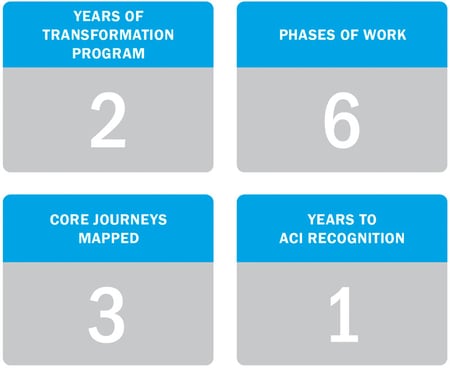
McorpCX was engaged by airport management and its partners to turn that vision into a customer-validated transformation plan. Over two years, work combined guest research, journey design, capability assessment, benchmarking, solution development, testing, and organizational transition.
We began with stakeholder interviews, focus groups, and quantitative guest research to understand needs, pain points, and expectations. Personas and guest typologies distinguished business travelers, vacationers, families, solo travelers, and other passenger groups.
We then mapped the departing, connecting, and arriving journeys across key stages, from pre-curb arrival and check-in through security, post-security, connections, baggage claim, and onward travel. The work exposed where confusion, waiting, wayfinding, and handoffs created friction and where digital and human support could improve confidence.
Leveraging our Experience Operating SystemTM (XOS), we also assessed the capabilities required to systematically manage experience. Guest Understanding, Measurement & Learning, and Governance & Accountability emerged as critical priorities.
Finally, we benchmarked airports at different levels of experience maturity, including Dubai, Schiphol, Heathrow, Gatwick, and Istanbul, translating guest, organizational, and competitive insight into a practical transformation blueprint. The blueprint supported near-term improvements and long-term organizational capability.
One year later, Airports Council International recognized the airport as the Best Airport in North America based on passenger feedback through its Airport Service Quality program. The airport began outperforming its two primary regional competitors, while passengers, media, and travel influencers increasingly praised how authentically it reflected the character of its city.
Employees and service partners also shared positive commentary about the airport as a place to work. The airport had moved from declining scores to differentiating through experience.


McorpCX is independently recognized as a top customer experience services and solutions company, enabling and guiding leading organizations since 2002.
Touchpoint Mapping®, Touchpoint Metrics® and Loyalty Mapping® are registered trademarks of McorpCX, LLC