


Measuring new member onboarding showed this credit union which fixes would boost loyalty and win more member business.
Challenge: Onboarding performance was unmeasured, and underperforming.
New members arrived predisposed to like this credit union. Referrals were the top reason people joined, and members described the staff as kind, knowledgeable and welcoming.
What happened after the application was uneven, and nobody could say how uneven. Leadership had plenty of anecdotes about the member experience and no measurement of which moments in onboarding drove loyalty, which ones underperformed, and by how much. Every improvement idea competed on opinion.
The cost was real. Only 50% of new members said banking with the credit union was effective, easy and enjoyable, and 15% said it was none of the 3. Among new members planning a purchase in the next 12 months, 28% were unlikely to choose the credit union for it.
Some of the challenges we identified:
Employees and members each had different views of what did and didn’t work well.
Irrelevant offers felt like spam to members.
Online and mobile banking lagged what members expected from their primary banking institution.
Branch and contact center wait times spiked at peak hours, making it hard for members to get help.
The website mattered most to new members and let them down the hardest, resulting in the biggest gap across the entire onboarding journey.
The constraints we had to design around included three business lines with independent tooling, content systems, and incentives; engineering capacity as the primary operational constraint; multiple improvement efforts already underway but unaligned; and no shared, customer-validated definition of what “good” looked like.
We defined the onboarding journey the way new members live it: apply and activate, welcome, onboard, relevant offers, and sign up for more. Then we measured performance at every step.
Moderated online discussion groups gave us member language and the specific pain points. A quantitative survey sized them. 789 new members rated 27 touchpoints and 49 wants and needs on importance and effectiveness. The difference between the 2 ratings gave a gap score for every element and every stage.
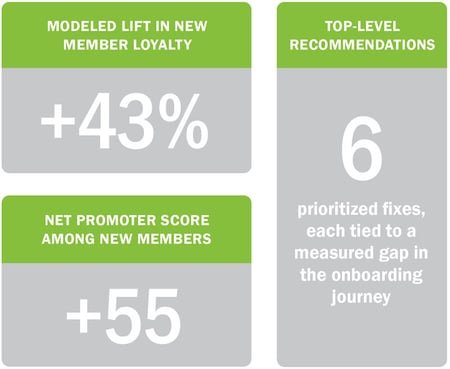
Causal modeling then showed which drivers move loyalty and which ones make the credit union a member’s primary bank. Staff effectiveness came first, and it carries more weight with new members than with the member base overall. Staff connections, professionalism and product fit followed.
We put the results on one page as research-based personas and current-state journey maps, so the marketing, digital, branch and HR teams worked from the same numbers.
Activities:
Executive interviews and an experience management capabilities assessment
Moderated online discussion groups, run separately for each member journey
Importance and effectiveness surveys across 3 member journeys
Gap analysis, driver regression and causal modeling
Personas, current-state journey maps and parallel employee experience research
Prioritization workshops, plus executive and board readouts
The credit union finished the work with a stage-by-stage measurement of the new member experience, ranked by how much each element influences loyalty and primary bank status.
Funding decisions got easier. Leadership could point to the welcome, onboard and signup stages, where measured performance sat below stated importance, and to the 43% loyalty lift available from improving the 4 key drivers.
The personas, journey maps and driver models stayed in use after the engagement. The marketing, digital, branch and HR teams shared one view of the new member and one prioritized, sequenced action list to drive desired results.


McorpCX is independently recognized as a top customer experience services and solutions company, enabling and guiding leading organizations since 2002.
Touchpoint Mapping®, Touchpoint Metrics® and Loyalty Mapping® are registered trademarks of McorpCX, LLC